Then There Was Lola
Brian collapses, Lola intervenes, and Crowe discovers that the medical history governing Brian's life may itself be the thing killing him.
When a one-legged escort saves a heavily medicated recluse collapsing at a Marylebone bus stop, she begins a recovery that uncovers a decade of misdiagnosis — and a chain of observation, exploitation and institutional blindness reaching far beyond the hospital.
Brian Ridley has spent most of a decade sedated into near absence by a diagnosis that was never properly verified. He lives above a takeaway in Marylebone, slipping between ordinary London and hallucinations of a Berlin he has never visited. When he collapses at a bus stop, Lola — an escort with one leg and no obvious reason to intervene — crosses the road and saves him.
At hospital, consultant Stephen Crowe discovers that Brian has effectively been poisoned by his own medical paperwork. As the medication is withdrawn, Brian's mind returns faster than his speech. Realising that everyone around him assumes he can understand nothing, he chooses not to correct them. His apparent invisibility becomes the safest and most revealing vantage point in the building.
Only Lola knows he is fully aware. Their friendship becomes the one relationship in the story that is not based on money, authority or surveillance.
Cedric, the hospital porter, runs a cheerful unofficial economy from his lodge: newspapers, favours, pirated bandwidth and information. He has also installed cameras where he should not have them, including in massage rooms and, out of private curiosity, in Lola's flat. He believes he is selling small pieces of access. He has no idea what the data trail from those cameras will expose.
Elsewhere, Jenny Ziehms — a GCHQ-adjacent analyst working from Switzerland — begins tracing that trail. The deeper she follows it, the less it resembles a porter's racket. Professor Simon McGinlay, a Harley Street consultant and Crowe's urbane mentor, appears repeatedly at the edge of events: calm, helpful and almost impossible to accuse of saying anything untrue.
Brian, meanwhile, begins to recover memories of his sister Elisabeth, a nurse whose destruction is tied to the same hospital. What he finally remembers drives him to act before any of the institutions around him have put the whole picture together.
The series is designed to be watched in order: information planted early changes meaning later.
Brian collapses, Lola intervenes, and Crowe discovers that the medical history governing Brian's life may itself be the thing killing him.
Brian quietly returns to himself and learns how much Cedric can see, trade and conceal from a position everyone else considers insignificant.
Private surveillance, hospital failures and intelligence work begin to overlap while Brian's recovered memory becomes increasingly personal.
Brian finally acts on what he believes he has understood. The result is violent, tragically incomplete and absorbed almost immediately into a larger state problem.
Brian Ridley wants first to be believed, and later to understand what happened to his sister. His recovered mind gives him agency and simultaneously presents him with a debt he feels compelled to settle.
Lola has arranged her life around independence. Her bond with Brian is the only important relationship she enters without negotiation or payment.
Stephen Crowe genuinely saves Brian and then spends the rest of the story proving that one good act does not protect a person from the consequences of the next bad ones.
Cedric is clever, useful, intrusive and fatally mistaken about his own importance. McGinlay is the quiet centre of manipulation: the man who rarely needs to lie because selection, timing and silence do the work for him.
The visual world is present-day London at an unglamorous level — Marylebone flats, hospital service corridors, Harley Street, an old pub and rooms with badly aimed cameras. Brian's hallucinations are treated with the same visual weight as reality, so that the audience shares his uncertainty rather than being told when to distrust him.
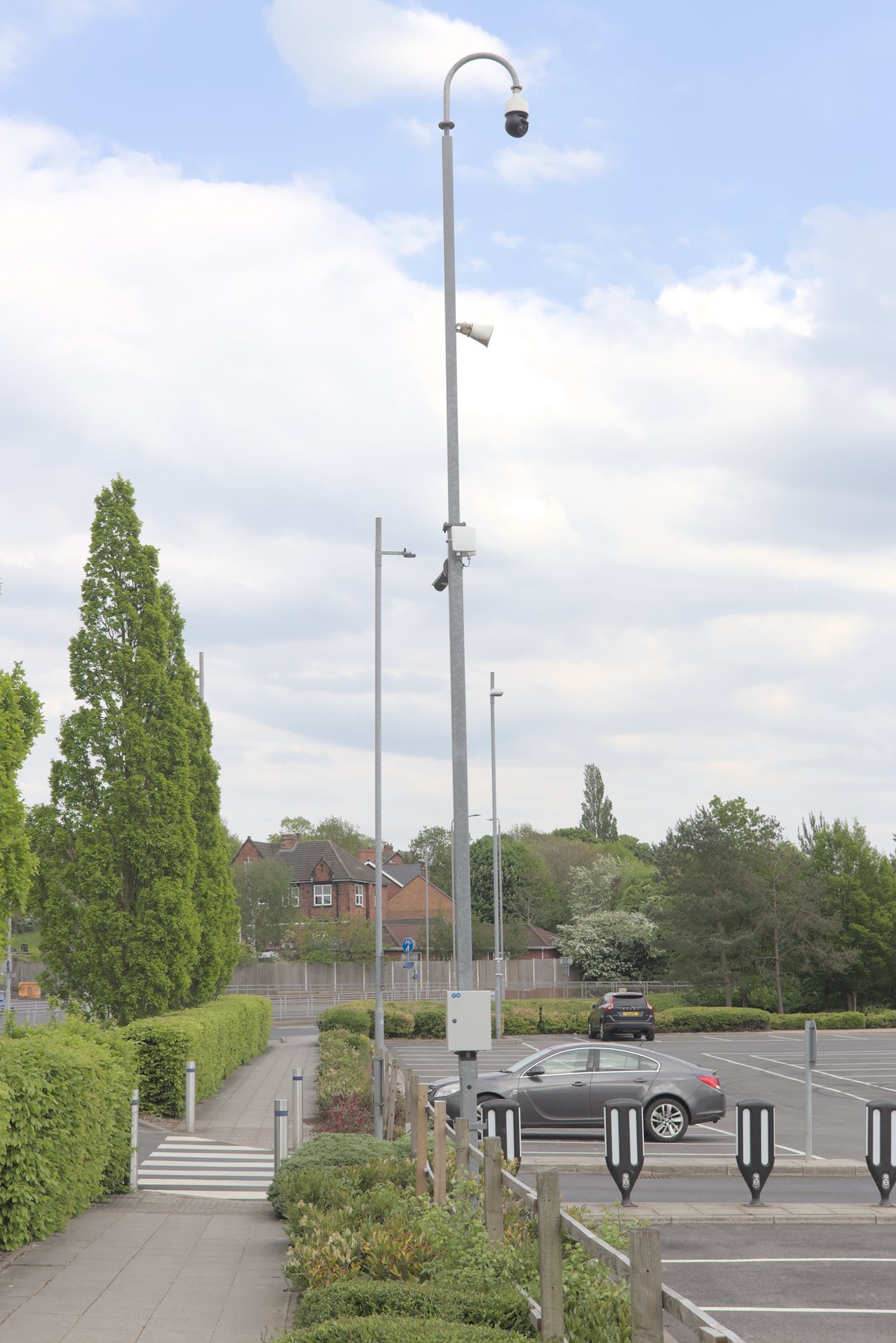
Surveillance reference image: CC0. It is illustrative development imagery, not a production still. Image credits.
← Current Projects